The Warm-Handed Wait: Belfast Gig Queues Are Becoming a Place to Eat
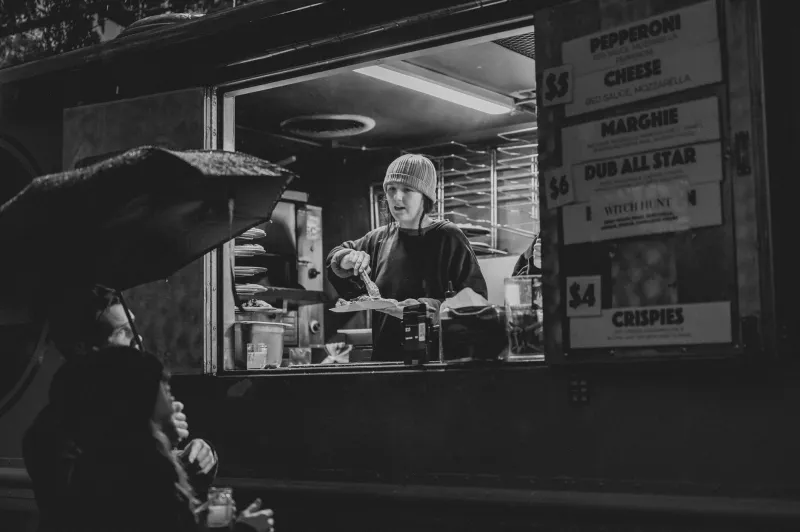
There is a moment, roughly twenty minutes before doors, when a Belfast gig queue stops looking like a queue and starts looking like a small, standing picnic. Someone has a paper bag of chips balanced on a rucksack. Someone else is holding two flat whites like they are live explosives. A third person is trying to eat a garlic chip wrap without getting grease on their ticket. The line shuffles forward, the food shuffles with it, and nobody seems especially surprised.
The queue starts before the doors
For years, the pre-gig meal was a sit-down affair: a rushed plate in a pub, a forkful of something before the first support act, a pint used as a timer. What has changed is the edge of the evening. The queue itself has become a place to eat, not just a place to wait. In Belfast, that shift is easy to spot around the Cathedral Quarter, along Ormeau Avenue and outside the city's mid-sized live rooms, where the pavement turns into a temporary dining room whenever a decent name is on the bill.
The reasons are practical. Doors often open at seven or half seven, which sits awkwardly between a proper tea and a late supper. Venues are strict about what comes in. The weather is not. And the city, helpfully, has a high density of chip shops, coffee carts and convenience stores within a short walk of most stages. The result is a food economy with no table service, no booking system and a very loose dress code.
A walking map of queue food
Start with the chip paper. It is the great Belfast queue food because it is hot, portable and forgiving. A single bag of chips can be shared, held in one hand and eaten with the other while you keep your place in line. A chip wrap is the more serious version: easier to carry, harder to drip. Regulars know to ask for it open at one end, like a savoury cone. If there is a queue-food hierarchy, the wrap sits near the top, just below the humble sausage roll, which remains undefeated because it fits in a coat pocket.
Then there is the coffee. Venue-run carts and nearby cafés have worked out that a gig queue is a captive market with cold hands. A flat white before a standing gig is a commitment, but a hot chocolate is a peace offering. On wet evenings, the queue's mood lifts visibly when someone appears with a tray of them. It is not dinner. It is central heating with a lid.
Within walking distance of the city's main live rooms, the options tend to fall into three camps: the quick chip stop, the bakery or sandwich shop that stays open just late enough, and the corner shop run for crisps, chocolate and something fizzy. Anyone who has done a Belfast queue in November knows the corner shop is not a compromise. It is a strategy.
Door staff, regulars and the rules of the line
Ask door staff about queue food and you get a shrug, a smile and a few firm rules. Nothing in glass. Nothing that needs a knife and fork. Nothing that will still be in someone's hand when they reach the bag check. Most venues are relaxed about a wrapped sandwich or a closed coffee cup, less so about a tray of curry. The queue has its own etiquette: eat before you reach the front, bin what you can, and do not stand directly downwind of someone who has just opened a bag of vinegar-soaked chips.
Regulars have their own rituals. One woman outside a Ormeau Avenue show said she always buys a flat white from the same cart because it gives her something to do with her hands while she waits alone. A man in a queue near the Cathedral Quarter said he treats a chip-shop stop as part of the ticket price, a tenner he budgets for before the band. Door staff describe the same pattern from the other side: the queue that eats is usually the queue that behaves. People with food are occupied. People with nothing but time can get restless.
There is also a quiet social function to it. Sharing chips with a stranger is a Belfast icebreaker. Asking where someone got their coffee is a conversation. The queue is a holding pen, but it is also a room without walls, and food gives it something to do.
When the queue becomes the scene
The interesting question is whether this is just convenience or whether the queue has become its own dining scene. The honest answer is: a bit of both. It lacks the polish of a restaurant and the permanence of a market, but it has the one thing that matters — a crowd with a shared purpose and a shared deadline. The food is not the main event on the ticket, but it is part of the night. It fills the gap between the day and the set. It gives the wait a shape.
Venues have noticed. Coffee carts appear where they did not before. Takeaways near live rooms learn the rhythm of a big show. Promoters talk about the queue as part of the customer experience, not just a logistical problem. That does not mean every gig needs a food stall. It means the pavement outside is now part of the venue's extended floor plan, and the people standing on it are hungry.
The practical plate
If you are joining a Belfast gig queue this winter, the rules are simple. Eat something warm before you leave the house, but leave room for a small, portable extra. Choose food that can be held in one hand and eaten without looking down. Bring a napkin, or accept that your sleeve is now a napkin. Buy the hot chocolate if the queue is long. And if someone near you is holding a chip wrap with the concentration of a surgeon, let them be.
The queue outside is not a restaurant. But on a cold November night, with the doors still shut and the first song still hours away, it is doing a very similar job.